
The Diabetes Data Rights Charter aims:
To articulate a set of principles that key stakeholders should consider to enable people with diabetes to safely and securely exercise control over their data in ways that best meet their personal needs and values.

What is the Diabetes Data Rights Charter?
Need for the Charter
Several legal frameworks already govern data rights, which manufacturers and data processors must follow. So, what makes a data rights charter necessary?
While companies may technically comply with data protection laws, they often do so in ways that make it hard for PwDs and other technology users to understand or exercise their rights.
There are clear asymmetries in power between manufacturers and users of diabetes technologies. People with diabetes (PwDs) often lack full access to their own data, which limits their freedom to switch between different—and potentially better—devices and restricts their ability to share data with healthcare professionals. These barriers reduce both the quality of care PwDs receive and their ability to make informed decisions about their diabetes management. Moreover, users are often not fully informed about what data is collected, how it is used, or with whom it is shared. This lack of transparency creates a continuum of risks that, at its most extreme, can result in personal data being shared with third parties who may not act in users’ best interests.
The Diabetes Data Rights Charter will guide diabetes technology companies toward clearer, more transparent data practice making it easier for individuals to control their own data.
The Charter will provide a set of best practices (above and beyond current regulatory requirements) against which industry can benchmark their product development to better meet the data needs of people with diabetes.
Driven by members of the diabetes community, the Diabetes Data Rights Charter sets out principles that define best practices for data use in diabetes technology, empowers PwDs to exercise greater control over their data, and calls on technology companies to work more transparently and collaboratively with the community.
The Diabetes Data Rights Charter is being co-created by people affected by diabetes together with researchers and legal experts from Birmingham Law School, University College Dublin, and the Steno Diabetes Center. Each partner brings unique expertise and experience to the project.
Since 2024, the team has organized seven roundtables involving more than 40 people with diabetes (PwD) from 16 different countries, each bringing diverse experiences with diabetes technologies. Guided by the principles of co‑production (every participant has an equal voice) the group has collaboratively defined the Charter’s purpose, scope, audience, and aims and helped shape its underlying principles.
A smaller working group of PwD is now refining and drafting these principles. Once complete, the draft Charter will be shared widely across the community for further feedback and discussion, ensuring it continues to reflect the lived experiences and priorities of PwD worldwide.
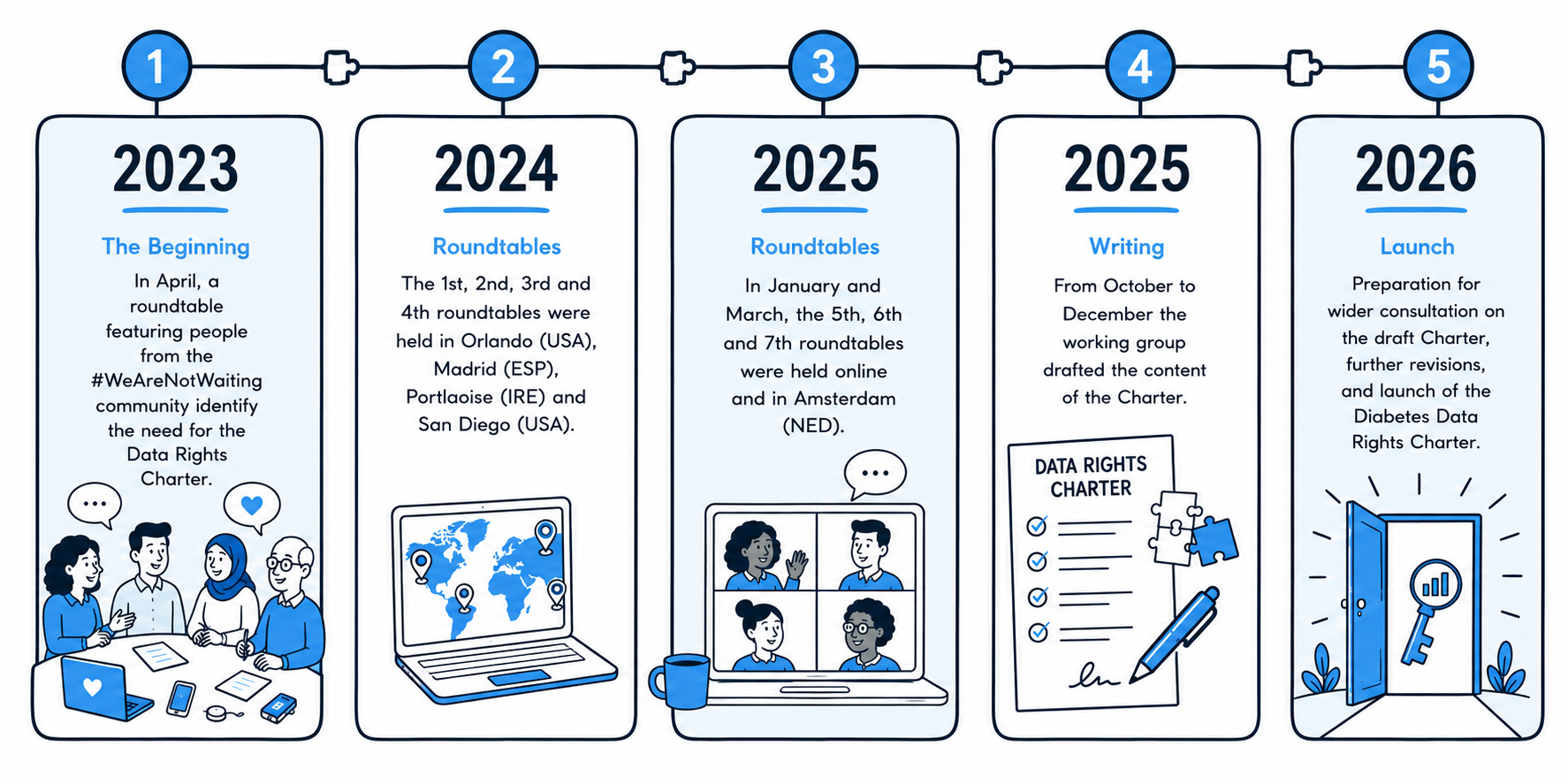
The journey began in November 2023 at the D-Data exChange, where a roundtable of #WeAreNotWaiting community members identified the urgent need for a data rights charter tailored to people with diabetes (PwD). This led to the first official Diabetes Data Rights Charter roundtable in June 2024 in Florida. Read the report here
Attendees agreed the Charter's core aim should be to articulate principles for industry and healthcare institutions, enabling PwD to safely and securely access and control their diabetes data in ways that meet their personal needs. Specifically, it advocates for person-specific open and secure access to real-time data (PeSOS).

The group also anticipated the Charter could:
Educate PwD and carers on the benefits of data access
Serve as an advocacy tool for data rights
Act as a checklist for industry and healthcare to better meet PwD needs
Support common data standards and interoperability in the diabetes ecosystem
Subsequent roundtables built on this foundation:
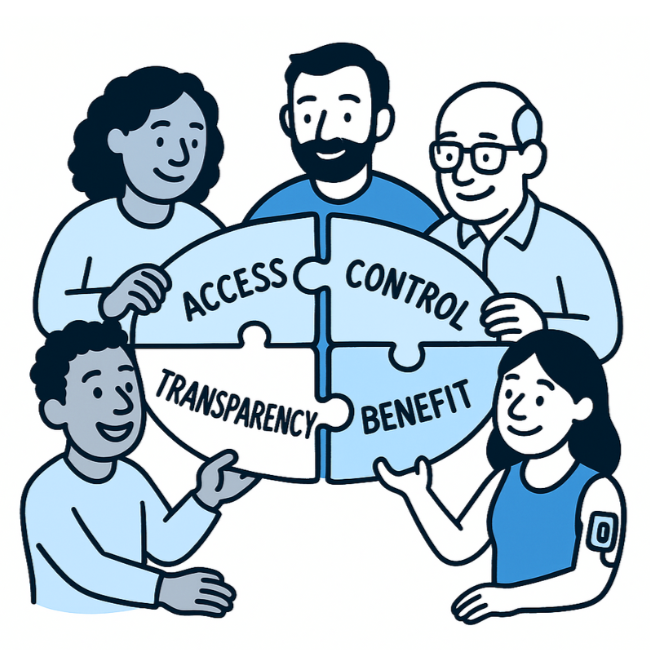
2nd & 3rd Roundtables (Madrid, Spain on 9 Sep 2024; Portlaoise, Ireland on 6 Oct 2024): Explored language, audience communication, and draft principles including access, interoperability, consent & control, privacy & data safety, benefit, technology & human intervention, trust & transparency, and responsibility. Read the joint report
4th Roundtable (San Diego, 7 Nov 2024): Refined candidate principles from prior discussions. Read the report
5th & 6th Roundtables (Online, 29–30 Jan 2025): Further honed the scope and content of the principles. Read the joint report
7th Roundtable (Amsterdam, 19 Mar 2025): Finalized which principles to include, their wording, and the overall Charter package. Read the report
Since then, a dedicated Working Group of PwDs has been refining the draft through intensive writing sprints (Aug 2025 - Jan 2026). A consultation on the draft in underway, followed by revisions (Apr–May 2026) and a launch later in 2026.
Diabetes Data Rights Charter Timeline
Publications
Why it Matters